Monday, August 15, 2011

The New Roman Missal: Some Thoughts


As you may or may not know, the Catholic Church has once more revised the Roman Missal's English translation so that it may more accurately reflect the original language of the Vulgate Bible. The changes are to be implemented during the season of Advent, 2011, and will supposedly rekindle faith and devotion for all who partake in.

To begin with, I would like to express a hearty "FINALLY" in response to this decision. The "translation" done in the 70's and 80's is so paltry, ineffective, dull, and irreverent that it is truly necessary to at last have an English text that does not try to summarize the contents of the liturgy, but actually attempts to translate them accurately.

This is not to say, however, that I approve entirely of the movement, not because I disagree with the efforts of the Church to more accurately disseminate the text of the Bible to lay people, but because I believe its opinions on the movement, as well as the goal of the movement, miss the obvious reality: that the music of English-language Catholic music is unashamedly awful.

Since the 1970's, the American Church has ruthlessly suffocated the true Roman tradition of Gregorian chant, and has frowned upon music that may be "too difficult" for lay people to sing (i.e. Medieval/Renaissance polyphony). For an institution that prides itself on espousing the Roman form of Christianity, and one that gloats over its universality as a single Church with one liturgy, it is incomprehensible as to why we suddenly need to sacrifice our 1,000-year-plus prayers and rituals in the name of gaudy simplicity, so that "the common man" can sing along in church. So essentially, the Church has allowed itself to stoop to the level of Disney Sing-Along in exchange for discarding one of the most sublime musical traditions the West has ever heard.

Let me be clear. The Church never catered to lay people's musical ability until the Reformation, when suddenly it became expected that everyone needed to participate in the liturgy. But this is not the original intention of Christianity. Indeed, early Christian rites were set up in mystery cult fashion, where the catechumens were the only ones allowed to partake in the Eucharist, and everything was done very hush-hush in the interest of secrecy and solemnity. But now under the guidance of the Enlightenment, we desire to expose the Mass in every way possible, to make it entirely accessible to even the most ignorant member of the congregation. We are now spoon-fed everything. No one has to work to understand the Mysteries anymore, no one has to work in order to pray or to worship. Everything has been simplified to the point where it is frankly sickening, and the Church has shot itself in the foot by this approach. How are we to expect people to regain excitement over a religion that has nothing to hide? that doesn't challenge us to dig deeper? The whole business of religion, whether Catholic or Protestant, has become too easy. No longer does one need to read St. Augustine or St. Thomas Aquinas in order to understand Christianity; no longer must one delve into the mystical writings of St. Teresa of Avila; no one needs to be able to read music anymore or to attend rehearsal in order to sing the prayers at a high quality. No, instead we have a degraded, insulting version of a once beautiful religion, and I am frankly angry.

What happened to strong-arm Catholicism? Where are the old monastic teachers of the universities? Where is the voice of reason? Where is the usual sternness of Catholic dogma? We are flailing about over all sorts of other issues in the name of "Catholic dogma," but are afraid to defend authentic Catholic dogma and practice. Are we that enamored with Marty Haugen's Mass of Creation, or Bob Hurd's hideous Mass of Glory? Who are these people and who gave them the authority to subject us all to their mediocre, uninspired swill other than the few liturgical music publishing companies? Why are we not fighting back? I know that there is
a large group of people out there who believe in the pure, timeless beauty of things like Gregorian chant, or the wonder of old polyphony. Under the spirit of reform, we must become a much louder voice and defend this body of music, or at least hold it up as a standard to meet. Not every parish is going to be able to implement such music - I am all too aware of this unfortunate reality. But why do we not strive to do so? Why are church choral programs full only of the elderly? Why is it that no one really enjoys singing in church anymore? Why is no one learning musical technique through the church as people did since the 8th century under Pope Gregory I? We simply must address the issue of quality in contemporary worship music. These people who consider themselves "composers" are blemishes on the history of Catholic music. It is appalling and unconceivable that these people should consider themselves part of the same heritage as Josquin, or Lassus, or Palestrina. It is like comparing stray cats to lions.

I am not a hardcore orthodox Catholic - not by any means. I believe that the Catholic Church needs to seriously reevaluate its stances on abortion, homosexuality, and female ordination, but I do NOT believe that the Church should be throwing away its liturgy so carelessly. I am an ardent (and clearly feisty) lover of early music, and as an amateur musicologist, it pains me endlessly to see this once alive music become the subject for faux-new-age CD's and techno remixes. I realize that this comes across more as an impassioned rant, but I am so distressed by how long this practice of sheer mediocrity has been allowed and desired by certain members of the clergy.

The sad truth is that this music no longer moves people in any way, no longer elevates them to a different plane of thinking or contemplation. Instead it is flat and dull. No amount of bongos, electric guitars, or flutes will ever remedy this. The false exuberance of these works are only a tacky veneer over poorly designed composition and text setting. Handel, not a native English speaker, set English better than these native English composers. And why is this tolerated? So that we can maybe appeal to some of the "young people?" I am a member of the "young people," and I can tell you that none of us are impressed by this garbage. None of us have found any yearning for God from these petty songs. But I know many of my generation who have been deeply moved by things like chant, and it has inspired them in a way unbeknownst to them before.

May God move as is according to His Will.
Amen


Wednesday, July 20, 2011

Eheieh: The Major Arcana and the Great Work

The Major Arcana are often seen as a representation of the individuation process, or the means by which man returns to God. There are of course 22 of them in total, but the last one, The Universe or The World, is numbered 21. Curiously enough, the gematria value for one of Kether’s divine names, Eheieh, equals 21 as well. Eheieh itself translates to “I am,” or “I shall be” – very interesting given what we have just said about the Major Arcana.

Another way of looking at the Major Arcana is by seeing their positions on the Rose Cross, depicted on the back of Crowley’s Thoth cards. Without getting too absorbed in an explanation of this complex symbol, I will simply say that it could be seen as another representation of the Sephiroth, or the way God manifests itself and then relates to its creation. From the single point of white in the center of the symbol emanates a rose and cross, followed by additional petals and a much larger cross. The single point represents Kether (Eheieh), the unity, or Hadit if you are thinking in terms of Crowley’s Liber AL. Surrounding this first small cross is a ring of three petals, followed by a ring of seven petals, and a third ring of twelve petals. Here is where we find our Major Arcana.

The first three correspond to the three elemental majors, which in turn are associated with the three “mother letters” in Hebrew (Aleph - air, Mem - water, and Shin – fire/spirit). These would be 0 The Fool, XII The Hanged Man, and XX The Aeon respectively. Technically there is a fourth elemental card, The Universe representing the element of earth, but since it does not correspond to one of the mother letters it is not placed in this first ring of petals.

The next ring of seven corresponds to the planetary trumps, these being I The Magus (Mercury), II The Priestess (Moon), III The Empress (Venus), X Fortune (Jupiter), XVI The Tower (Mars), XIX The Sun (Sun), and XX The Universe (Saturn).

The third ring of petals on the greater rose represents the zodiacal trumps. These are IV The Emperor (Aries), V The Hierophant (Taurus), VI The Lovers (Gemini), VII The Chariot (Cancer), VIII Adjustment (Libra), IX The Hermit (Virgo), XI Lust (Leo), XIII Death (Scorpio), XIV Art (Sagittarius), XV The Devil (Capricorn), XVII The Star (Aquarius), and XVIII The Moon (Pisces).

What this symbol tells us is that each ring is a subsequent emanation of the ring before it, a further distillation of the meaning inherent in the cards prior. What I propose is that we can group the cards in families based on element, and thereby come closer to pinpointing what the 21-fold path to God is intimating.

Fire:

First, let’s deal with the fire cards, since Kabbalistically, fire is the first element, followed by water, air, and earth. This set is governed by XX The Aeon, which stands for the element of fire and spirit simultaneously. We are told that this has to do with the consumptive and enflaming quality of spirit. Fire is also attributed to the letter Yod of Tetragrammaton, and Abba, the Father who is represented by Chokhmah on the Sephiroth. XX essentially represents the Second Coming of Christ – the divine Self – who destroys the individual’s worldview and comes to rule over the soul as a lord. This, as we will see, is the overarching theme to the fire trumps. It is echoed in the two fiery planetary trumps, XVI The Tower and XIX The Sun. The former symbolizes the destruction of the ego’s fortress by the spirit. It is akin to the Harrowing of Hell by Christ following the Passion, when the Lord descends to the depths to liberate those trapped in Hell who did not deserve to be there (namely the beatific characters of the Old Testament). XIX on the other hand represents liberation, particularly from self-deceit, victory and triumph, the return of innocence, the Crowned and Conquering Child. Both of these planetary cards can clearly be seen as further developments of the original main idea contained in XX The Aeon.

The three zodiacal trumps for fire, IV The Emperor, XI Lust, and XIV Temperance, all also deal with these themes, but in a more specific fashion. The Emperor speaks of self control and self-lordship. He is a man of war being also associated with the alchemical sulfur. He is sudden in his actions and occasionally destructive without care. We can see that this represents the war against the ego, which flies about with little sense of direction. To tame it, we must be equally sudden and sometimes ruthless in our governance. We must consider its losses as a delight, and not something to mourn for. This is man’s innate “will to power” put to good use; rather than using it to destroy one’s peers, we can use it to destroy our false selves and thereby attain true Power. XI Lust also has the same nonchalance when it comes to its potency – what it destroys in its unleashing is quickly forgotten about. Lust represents the erotic union between masculine and feminine energies that are both inherent in the human being. The energy generated by this is enough to cause the Kundalini serpent, coiled at the base of the spine, to rise. Being situated in that place on the body, the serpent represents a very wild, natural energy form that can be seen as an effect of our “lower sensibilities.” By causing it to rise, we are bringing these “lower” essences more in line with our divine energies. We allow them to be governed more easily by spirit, or the Divine Self. XIV Art again deals with the harmonization between masculine and feminine, itself being a depiction of the androgyne. These energies are refined to their purest forms and then fused back together into a unified androgynous being – a more accurate representation of the Divine Self.

Understanding this, we can see that the fire trumps all deal with the War against the false self, as well as the governing of the human being by spirit, the Logos as represented by Christ.

Water:

Next comes water, which represents the Divine Feminine, the Mother, Binah on the Sephiroth, Aima, the Heh primal of Tetragrammaton, etc. So while fire represents the Divine Will, water is the actual understanding or interpretation of that Will. Therefore, we should expect the water trumps to further explain the fire trumps in a more passive way. Its elemental trump card is XII The Hanged Man, which is a curious and sometimes frustrating card in my opinion. It’s one of the trumps that Crowley felt needed revision since it so obviously depicts the mysteries of the Aeon of Osiris which has supposedly now passed. Primarily, he rejects it as a symbol of sacrifice conflated with morality. But while sacrifice may no longer be a relevant action today, the card still represents the descent of the Divine Self for love – not love in the sacrificial sense of Christ, but in the ecstatic form described by Nuit in the Liber AL (“for I am divided for love’s sake, for the chance of union”). An important aspect of the Hanged Man is that he is upside-down, meaning that his perspective is seemingly opposite to our own. Yet, Crowley writes that water is an element of illusion, and it would seem that the Hanged Man’s perspective is actually correct, and our own is deceptive. Thus, we “understand” the effect of XX The Aeon. The Aeon rectifies our perspective, and demonstrates to us that we are actually divine beings.

II The Priestess, or the Moon, is the one planetary trump for the element of water. Again, the card represents the truth concealed behind illusion. Manifested existence is simply a lovely guise for the One Truth – the One God, who hides himself therein. Now, we must compare her to the fiery planetary trumps, XIX The Sun, and XVI The Tower. These two cards also represent the shattering of illusion by Spirit, the Second Coming. The Priestess is the passive version of this, secretly telling us through our intuition that the form represented by the Tower was false, and that the only Truth is that of the Sun. We must remember that in Neo-Platonic thought, the sun was the closest representation of the Monad man could conceptualize. Mystical experience with the True Sun in this philosophy was the first major step towards union with the Source, as the two are so similar. The fact that the Priestess hints at the secret unity of life shows that she is in a direct relationship to XIX The Sun. So far, both the fiery and watery trumps have expressed practically the same ideas within their specific hierarchic levels. (In other words, the elemental cards express the same idea, and the planetary trumps together express another idea.)

The zodiacal water trumps are a bit trickier, though our theorem is still applicable. VII The Chariot represents control over the soul by the hidden One God. Ultimately, all actions of the soul are set in motion by God. By further defining the Hanged Man, we can see that whatever agency we believe ourselves to possess is false, and the only real authority possible is divine. Additionally, the card’s meaning is similar to IV The Emperor, but we see that the Emperor’s agency comes not from man himself, but from God alone. The Emperor is the pure idea of divine authority, the Chariot is a deeper (and therefore less pure) interpretation of that governance. Another, more simple way of comparing them is by noting that both are images of war and conquest. Though, while the Emperor is more spontaneous and active as a conqueror, the Chariot is simply directed and does not have a specific target of conquest.

XIII Death is also a card full of illusions and misconceptions that must be wiped away by the Spirit. While unaware of divinity, we believe in and fear corporeal death. It also speaks to the Dying Man-God Formula espoused by the Aeon of Osiris and the Hanged Man, as it represents Osiris himself. Osiris is the closest analogy to Christ we can find in the Egyptian Mysteries, and was most likely the ultimate predecessor to the archetypal story of Christ’s Passion. This card seems to be the most layered in its relationships to the element of water and its complement, XI Lust. Lust, as we know, represents the erotic fusion between masculine and feminine archetypes within the individual. On one hand, Death could therefore represent the death of orgasm when the two halves no longer distinguish differences between each other. On the other, Death shows us that whatever manifestations our personality goes through, each one is ultimately brought about by our pure Divine Self, who seeks to rectify our nature. Death purges us of unnecessary things, which causes us to feel “pain.” But this pain is a sort of divine ecstasy as it brings us closer to God.

Lastly, XVIII The Moon is entirely about deception and fear of the unknown. Without knowledge of God, we flounder through life feeling lost and confused about the future, our ambitions, who we are, almost anything you can imagine. Yet, buried deep under all that muck lies the sun waiting to be reborn. Note that each zodiacal water trump has depicted the Divine Self or Christ in some form, almost always in a solar aspect. The Chariot represents the “blood of the Sun” contained within the Holy Grail; Osiris, a god of vegetation and rebirth is naturally quasi-solar; and Kephra, the beetle, rolls his solar disk through the underworld. But XVIII is once again a hieroglyph of truth concealed in illusion. It resonates with XIV Art in that both of them show a sense of direction. While Art shows the path to balance and the Divine Self, the Moon demonstrates the need to stay connected to that solar middle path. It also speaks to the confusion created by the separate needs and desires of our masculine and feminine halves, as the cards two towers stand darkly opposing each other. The path between them is tread by Kephra, the sun.

It seems clear now that the water trumps depict the passive side of the “War” against self. They show different sides of the fire trumps by giving them more definition.

Air:

Air is the element attributed to the Son, the Vav of Tetragrammaton, and Tiphareth (the sun) on the Sephiroth. This is the heart of the Divine Self and the active consonance between the Divine Will and the Divine Understanding (fire and water). It is primarily defined by 0 The Fool, the letter Aleph. The Fool represents the wandering prince/knight-errant, perhaps even the incarnated Christ. He stands for divine mania, innocence, purity, fertility, ecstasy, androgyny, etc. He is the result of the fusion of masculine and feminine – by doing so he has regained his divine nature, and life becomes less of a grim struggle and more of a playground with little intrinsic meaning other than enjoyment. He can also be seen as the opposite and real nature of the Hanged Man.

The two planetary trumps for air, I The Magus and X Fortune, both speak of power and agency. The Magus shows that, with the War being won, the individual is free to craft their reality as they choose, since they will have discerned the illusive quality of existence and transcended it. Also, the Magus represents the alchemical substance of merucury, which is considered to be androgynous and a hybrid of sulfur and salt. Fortune echoes this, for the card tells us that as long as we are not in control of our multiple personas and powers, we are equally not in control of our lives and the seemingly “random” events that occur in them. Being an aspect of the Fool, we learn that all of the events that we want to take seriously really are just neutral events that are there to instruct us. In the case of the Fool, however, he is in control of the hand that turns the Wheel. Note that the Wheel of Fortune has a clenched fist engraved on its rim at the bottom; from this radiate six violet rays. Six is the number of the sun, as it is the number of Tiphareth on the Sephiroth. Essentially, the “hand of fate” is our solar, divine, Christ-like True Selves. The Fool, having recognized this, is free to manipulate his own destiny. Additionally, the Magus may further be a representation of the incarnated Christ, as the god Mercury is also a psychopomp, meaning he guides the souls of the dead. He is able to connect the highest to the lowest (“As above, so below”) and thereby redeem the lowly. Perhaps the ultimate message is that our highest good in the material plane expresses itself through our desire for freedom without prejudice against others. The Fool is indiscriminate because he is too innocent to pass judgment.

Which, of course, makes VIII Adjustment so interesting. Adjustment has nothing to do with any moral evaluation, only equilibrium. I believe we will find that the three zodiacal air trumps deal with the power and agency of the incarnated Christ, though I admit the air cards are particularly difficult to pin down (which makes sense, given the nature of air). But Adjustment, coming as a reaction to the harmony between the Emperor and the Chariot, teaches us that any action taken will have its repercussions in nature. Now that the individual has gained mastery over themselves by attaining Divinity, their lower selves (the Heh final of Tetragrammaton, the Princess) have been rectified and equilibrated. Its usual pendulum-like behavior has been balanced, thereby placing the Daughter on the throne of the Mother, Binah. Remember that Crowley writes that this card depicts that moment prior to her enthronement. She holds the sword of the Magus because with it she has focused all of her being toward this one goal.

XVII The Star, interestingly enough, comes as a response to Lust and Death, and depicts the manifestation of Nuit, the goddess of infinite space and nothingness. The letter associated with the Star is Heh, the letter of the Mother and Daughter, or Binah and Malkuth on the Sephiroth. The Star tends to represent that infinite potential of the universe encapsulated within the divine human being. All events for her are representations of the universe’s love. Primarily, we can see how this is connected to the ideas of the Magus and Fortune – as a divine being, man can access the infinite power of Divine Will (note that she pours upon herself the liquid spiral energy of a golden, a.k.a solar cup or bowl). She herself has become the conduit for the Divine Will and dispenses her blessing on the manifested Universe itself. Remember also what Crowley says, that all events are “a play of Nuit.” So after the ecstatic union achieved in Lust, understood to be a sort of release from the false self in death, the Star sees herself not as a divided being, but as one who contains both masculine and feminine impulses within herself, or perhaps rather the potentials for both.

Lastly, we have VI The Lovers, which is the counterpart to XIV Art. The former represents the alchemical act of solve while the latter is coagula. Both represent marriages of some kind. Let us remember that all magical working deals with these two activities – one can either divide or assemble when it comes to the goal of a magical operation. In fact, these are the only two operations of the Universe as a whole. Again, we see the empowerment metaphor of the Fool/Christ as reigning Lord. In response to Art and The Moon, the Lovers seems to decidedly advocate for separation, as the Hermit or Logos stands in the Sign of the Enterer, as if to authorize the marriage between man and woman. But, remember that The Lovers has a strong female element, as it is the influence of the Mother Binah upon the Son in Tiphareth. Perhaps we can see this card as a reminder to the Son of what his primary goal is – to marry the Princess and redeem her. In this light, perhaps the Prince has been given all this power and agency to entice the Princess.

It intrigues me that even though the element of air is meant to deal with the Son of Tetragrammaton, the reigning Christ after his fiery return in XX The Aeon, there is a strong presence of femininity in the zodiacal trumps. While we can suggest this is only natural given the Fool’s androgynous nature, it may also be intended to remind us of the Tetragrammaton cycle and the process of apotheosis. The Prince is always intended to marry his sister the Princess and set her upon the throne of her Mother, whereby she awakens the Eld of the All-Father and becomes one with God. So in the air trumps, we see the actual goal or focus of all the activity in the fire and water trumps – the redemption of the Princess. It is as if the entire force of creation surges to save her in loving joy.

Earth:

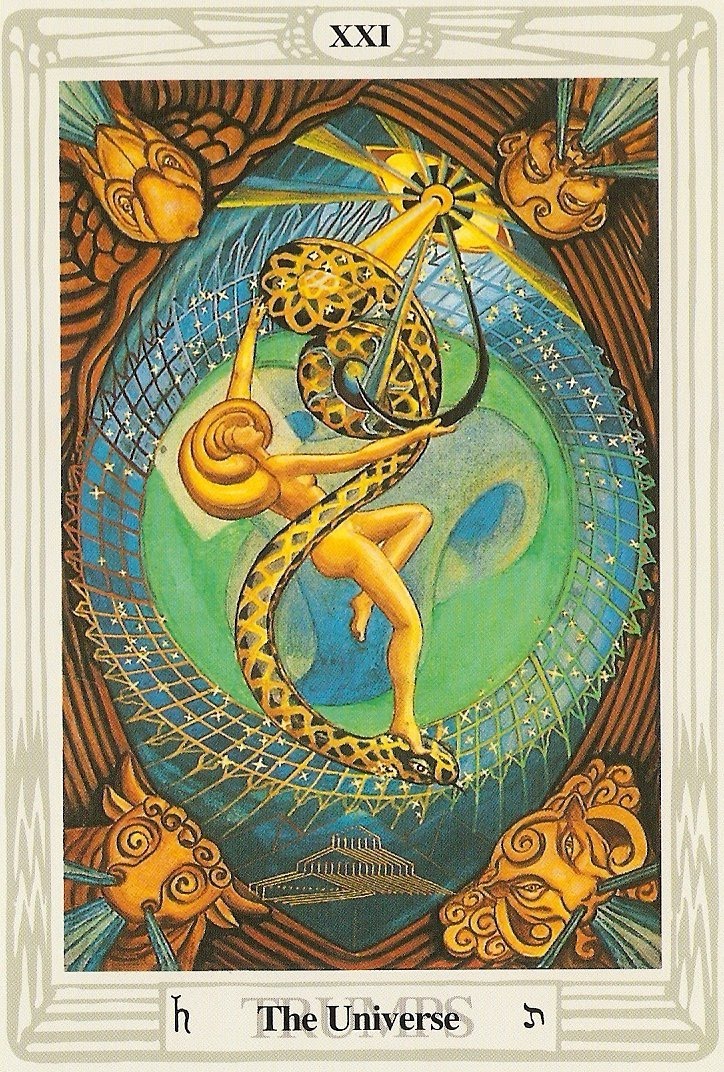
The last of the elemental trumps is XXI The Universe, which represents the Daughter fully enthroned in the New Jerusalem or Eden. It is akin to the Assumption of the Virgin into Paradise. At this point in the apotheosis formula, the Prince, along with any sense of individuality, has been sacrificed, allowing the Princess to be a complete vessel for the One True God – or rather, to actually become one with God. It is the fulfillment of the prophecy that the Kingdom of Heaven shall come to reign on earth.

The Universe is also Saturn, and along with III The Empress, constitutes the planetary majors for earth. As definitions of the New Eden, they both possess a sense of longevity and eternity. The Empress is the alchemical substance of salt, which represents death, slowness, inertia, etc. Saturn similarly represents the heaviness of time and its procession onwards. So having attained Godhead, the individual has also become one with Eternity. There is only one moment in this state – an eternal present; the past and future are not relevant. Furthermore, what was begun by the Masculine (IV The Emperor) has found completion in the Feminine (III The Empress). Venus as a planet represents beauty and love, and thus we see once again that all the work of the Universe has been ultimately an act of love. Paradise has regained its greenness as Hildegard von Bingen would say, and is once again beautiful.

For Crowley, XV The Devil is a representation of Kether, the single and only true perspective in the Universe. He is a symbol of mastery and initiation, but is also ruled by Saturn. The card is also a representation of the incarnation of the divine in matter, represented by the large phallus depicted in the card. But the idea is that God chooses to manifest Himself for better or worse. Let us also recall the traditional Neo-Platonic mythology surrounding apotheosis. Upon returning the unity, the individual is expected to return their eros or life energy to the demiurge so that He can create new forms. This is what it means to “pour one’s blood into the Cup of Babalon” and to thereby “awaken the Eld of the All-Father.” One has completed the work of self-mastery set out in The Emperor, The Chariot, and Adjustment. By becoming one with God, one partakes in the profoundly beautiful act of creation.

V The Hierophant is the hieroglyph of teaching and spiritual guidance, of exoteric revelation. As Crowley would say, he has become Master of the Temple by reaching Paradise. It is his duty to now instruct others who have not received initiation, to guide them toward Truth. His letter, Vav, means “a nail,” and is again a phallic symbol. He must generate spiritual progeny by infusing others with his inspiration. Even though he has completed the Great Work, he must continue to participate in it.

One last card, IX The Hermit (phew). Let us recall that the mutable zodiacal trumps have tended to do with the direction of willpower. Sagittarius directed it toward the Divine; Pisces hid the divine goal from the will and let it wander alone; Gemini taught the will to cleave to the Divine, but also to embrace the properties of division inherent in the Universe. Now the Hermit is a representation of the Divine Will working silently throughout nature, as its sign, Virgo, is ruled doubly by Mercury. But Mercury as psychopomp also seeks to redeem the individual soul – hence the depiction of Cerberus in the card’s lower right corner. And in the Hermit’s hand, he bears a lantern containing the sun. Through the guiding hand of the Logos, the Universe is cultivated and returned to its paradisical state. Again, we have a call to continue the Great Work until the whole Universe is integrated. It is no longer about the will of the individual, but about the Will of God. Also, we see a spermatozoon in the lower left corner, demonstrating the impregnating effect of this Will. But it is of course yet another phallic symbol.

Therefore, the earth trumps deal with Garden of Eden, Paradise, the New Jerusalem on Earth. They complete the apotheosis of the individual, but by doing so makes them an even more integral part of the Great Work for existence itself. On a personal note, I must add that this is exactly what Hildegard von Bingen writes about. She constantly talks about the need to return Paradise to its original green state prior to the Fall and the Incarnation of Christ.

Wrapup

We have talked about every single trump, and I’m exhausted. But I believe I have touched upon something very important, and I hope it clarifies the apotheosis process for all of us. I also hope it shows us how the trumps are all thematically related, and do ultimately demonstrate Eheieh, the unity of life.

If you have any questions, please let me know.

Sunday, July 10, 2011

One Year Anniversary!


Yes, my friends, today marks the one year anniversary of my opening this blog. Since then I have graduated from college, sung the Brahms Requiem more times than I care to recollect, and prayed more than I ever have before. As a blog writer, I have veered into all sorts of subject matter - from the letters of Abelard and Heloise, to the mysteries of Christianity, to the musical integrity of pop artists, to the esoteric nature of tarot cards. Yes, we have covered a wide spectrum of titillating topics, while attempting to maintain academic quality, profound insight, and suitable questioning.

So first and foremost, I must say thank you to all of my subscribers (all eight of you). I hope you have enjoyed this year as much as I have, and I hope even more that you will continue to participate in the dialogue here. I would also ask you to please come to me if you ever have any questions or topics you would like me to discuss. I am here for help on tarot, religion, and general life advice.

Therefore, my primary goal for this blog over the next year is to foster more
of a communicative environment. I want you all to feel like you can contribute to this blog by sharing your own insights or experiences, or by coming to me with questions.
It's very important to me that my readers feel they are part of a small but inquisitive community of genuine thinkers, because, after all, the Internet is designed for communication, information,
and sharing.

Thank you all, once again - cheers for one year down! And for the ones to follow as well.

All best,
N

Monday, July 4, 2011

Kundalini Rising: Interpreting the Princesses of the Tarot


So this is not going to be one of my more coherent or well-thought out posts, but I was due for an update, and this has been what's on my mind lately.

In Hermetic Qabbalistic writing, we are constantly made aware of the fact that the holy Name Tetragrammaton (YHVH) "revolves," meaning that it represents a cyclical process of creation. The Yod represents the Father, who imagines the primary archetype or concept of a being; the Heh primal is the Mother, who formulates this into an actual image and gives it more definition as to what it can and cannot be; the Vav is the Son, the actual projection of this idea in space and time; and the Heh final is the Daughter, who is left oddly ambiguous. Now, these letters correspond to the four elements - Yod is fire, Heh primal is water, Vav is air, and Heh final is earth. But we are reminded by Crowley in his Book of Thoth that the only real elements upon which creation is based are the first three: fire, water, and air. This is because they correspond to the three Mother Letters in Hebrew, Shin, Mem, and Aleph respectively. Tau is attributed to the element earth and the planet Saturn simultaneously, much like Shin, which is both fire and spirit. Added to this information is the fact that each letter of the Name correspond to a sephira on the Tree of Life: Yod is Chokhmah, Heh primal is Binah, Vav is Tiphareth, and Heh final is Malkuth. This is important because we are also reminded incessantly that Malkuth is more a "pendant to the Tree of Life" than anything else. It's sort of just there for kicks, for lack of a better explanation. And lastly, in tarot, the Yod is the Knights of the court, the Heh primal the Queens, the Vav the Princes, and the Heh final the Princesses.


So then who is this "princess?" Based on these attributions I've laid out here, she seems vague and almost identity-less. She has no new letter to go with her (as she is another Heh) and she isn't considered to be that important from a Sephirotic perspective. But Crowley and others are insistent that she is the key to it all, as she is destined to sit on the throne of her mother and "awaken the Eld of the All Father." She is able to do this because she is of the same substance as her Mother supposedly, as they share the same letter (Heh); they are similar in essence. But this is ultimately not very helpful, at least in my opinion. We still cannot define this relationship.

Now, I recently stumbled upon this article: http://supertarot.co.uk/thoth/fool-pole-star.htm written by Paul Hughes-Barlow. I suggest you read it, because it raises the very interesting point that the Princesses are synonymous with the aces of the tarot (remember, they are the "thrones of the aces), and the aces apparently were connected with the constellation of Draco, who encircles the north pole. I find this to be particularly interesting because, of course, a dragon is also a kind of serpent, and we know how fond of serpent iconography Mr. Crowley was.

The primary connection between serpents and tarot, however, comes in the
form of the Lust card, atu XI. Its letter is Teth, which as a word translates into "serpent," and is associated with the sign of Leo. On the whole, it signifies the conjoining of the solar masculine sexual principle with the lunar feminine sexual principle in one rampaging, orgasmic, explosion. Additionally, while the idea of a sexual serpent immediately brings to mind the phallus, it also represents the Kundalini serpent, coiled at the base of the spine. But Kundalini is also sometimes interpreted as a goddess, a kind of offshoot of the goddess Shakti, who is the primary creative feminine deity. Sounds like the Great Mother Binah (Heh primal), right? Kundalini strives to climb up the spinal column and attain union with Shiva (in Qabbalah, this could be seen as the Ain Soph, or Chokhmah even). What does this sound like?? Exactly! The Princess who longs to arrive at the throne of her mother in order to make the All Father a very happy creative being.

So this would explain why the Princess as a representation of the body and the lower sensibilities is so powerful and miraculous! The lowest of the low is tremendously exalted in this case, for even though the Kundalini serpent begins at the lowest chakras, those associated with primal urges and desires, it possesses an unfathomable amount of energy that can rise upward and attain godhead (literally). Along the way, in its intense desire for the beloved, it has the incredible ability to break down the ego, finally eliminating it entirely upon reaching the sephira of Binah, the throne.

In this light, perhaps we can understand why the princesses have the personalities they do. The princess of wands would represent Kundalini in its purest form - the sheer will and force of it as it strives upward. This requires a sort of optimism and innocence, which is perhaps why the Fool's tiger is with her. The princess of cups would then represent the sheer ecstasy and brilliance associated with Kundalini Awakenings. Her swooning would make perfect sense, as well as the swan on her head, which supposedly represents the unity of life (OM). The princess of swords, however, is a bit tricky. Being associated with air and the mind, I would suggest that she represents the revolt of the ego against such an aggressive assault against it. The ego loves to fight back, and I'm sure that it would feel a particular urgency to do so after so fiery an attack as a Kundalini Awakening. Though, we could also simply see it as the general aggression of the Kundalini, and the general impartial destructive quality it possess. And lastly, the famous princess of disks - one of my personal favorites. We are told that she represents the sum total of womanhood and the quietude of the body. The first part mostly means that she is the full summation of Nuit, the infinite goddess of Nothing from which all this comes from. But the second part surely speaks to the ultimately calming affect Kundalini has on the body. By negating the ego, it helps bring the body into greater submission to the Divine Will, which would explain why she is impregnated. The process of coaxing the Kundalini up the spine also takes work, dedication, and purity, all of which are associated with the princess of disk.

These are all thoughts ultimately, and are not really coagulated into a coherent argument, as I said at the outset. But it is certainly an interesting way of looking at the princesses of the tarot. Please leave a comment if you have something to suggest!

Saturday, June 18, 2011

Music in America: Lady Gaga Revisited


It is by no means my intention to turn this into a Lady Gaga blog, but I will confess that I am a fan. Furthermore, this blog is partially about music and culture, so I believe it's perfectly valid to discuss something like Gaga's new album, Born This Way. I have now had to defend this album against far too many people, and every time the same issues seem to come up. Let me get to the point: for the American public, Lady Gaga has become too artistic. Yes, that's right. A music artist has become too artistic for mainstream America, and her ratings are subsequently sinking. I do hope with every bit of my being that you find this statement to be absurd, because it is the epitome of absurd - and yet, I'm not surprised in the least.

Let's face it, pop music was never invented to be profound. With the rise of the recording industry, coupled with a simultaneous bout of post-war trauma and American over-confidence, American music became so dumbed-down as to become pointless. Music became such a part of the mundane that it was quickly taken for granted, and capitalist record companies, eager to sell as quickly as possible, churned out a continuous spew of mediocrity that still plagues us to this day. This sort of capitalist swill, created supposedly for the sake of the masses, was quickly exported and shoved down the throats of many countries' populations. I am painfully reminded of Chile in the 60's, where the gross influx of American pop music sparked the Nueva Canción movement, a grassroots, pro-Socialist, indigenous music revival. This is pop music's origin; it is a genre based on keeping people ignorant, and blithely happy about nothing of any substance. Its subjects are usually so irrelevant that there is no real point to questioning the genre as a whole; people don't have to work in order to understand it.

But Western music history shows us that this is not what music has to be about. As Westerners, our heritage consists of composers and music makers who put titanic amounts of thought into their work, and expected their listeners to do the same. Once upon a time, the dialogue between artist and audience spurred by a challenging piece of music was something to be excited about! People wanted the librettos to operas in advance so they could study them before they went to see them performed; Renaissance printers made countless copies of the latest Italian madrigals for people to sing together in their homes; Haydn paid for the publication of his tour de force, The Creation, in both English and German, and set up a subscription system so that members of the public could gradually get their hands on the entire score; Wagner had fan clubs across Europe because people were so obsessed with his artistic vision; and today, musicians are still struggling to play pieces "as the composer intended." I could of course go on, but the point is this: in the West, music has always been considered an art of some kind, and with this definition comes an expectation that music will foster some kind of discussion or exchange of ideas.

But pop music, by nature, shuts this dialogue down. What's the point of doing a musical analysis of Britney Spears's "Hit Me Baby One More Time," or discussing the ideology of Train's "Meet Virginia?" Even songs that could be considered more in-depth than the more poignantly superficial ones are usually not so profound as to spark nation-wide arguments. Now, I understand that pop music is meant to let people just have fun. In some ways it's important to have an unpretentious, simple music genre for people to let loose with. But it's equally important to keep the public thinking. I also understand that not everyone listens to pop music, nor is it the only thing a person may listen to. But the fact that it chooses to label itself as "popular" demonstrates that it's a genre that believes itself to be accessible and likable for the general populace. It reflects a certain over-arching mindset when it comes to American music, and quite clearly tells us that American music should be simple, pointless, and fun, and not much else.

But Lady Gaga is different, and this is why she's so important to American culture. She has single-handedly attempted to turn a genre of music inherently anti-artistic into an art form. In the footsteps of Warhol and countless other modern artists, she has converted the mundane blandness of pop music and culture and turned it into something worth talking about. Her music and performances are controversial not just because their subject matter can be racy, but because they seek to penetrate and dissect the lifestyle that has sprung up around this type of music. Most of her music is trying to get you to think about something, sometimes several things at once - just like a good artwork will. I strongly believe that even if you dislike a piece of art, if it makes you question your own aesthetic values, your ideology, or your general perceptions, then that artwork was successful. It pushed you out of your norm and forced you to think of life in a broader scope. And this is what frustrates me so much about the mainstream criticism I've been hearing from people when it comes to Born This Way - the biggest complaint I hear is that her music has become too message-ridden. Heavens! Songs that make you think? Songs that make you angry or empowered or both? Songs that you can have a visceral connection or aversion to? What is the world coming to!?

So essentially, Lady Gaga has played the most genius cards I've ever seen. She has invaded the pop industry to seriously partake in it, and simultaneously criticized and questioned it. She has made millions fall in love with her and as many come to hate her. But this is not the same sort of distaste one expresses over other pop artists - when one condemns Britney for being talentless, they don't do it with the same sort of scorn that I hear the Gaga-haters toss around. There's a real anger present here that must be recognized, and at the same time appreciated. Lady Gaga, like it or not, has created a schism in this country by forcing us to ask ourselves the question, "what do we want to get out of our music?" Do we want pointlessness and fun? or do we want art? For the first time in a long time, we have the option to choose both, but with the awareness that the artist herself is cognizant of her genre's pointlessness.

Let me also be very clear about Born This Way as an album: I think it's bloody brilliant, and I wish more people would hear it the way I and many others do. I have heard people say it's not a cohesive album, that it's just edgy for the sake of it, that it's over-produced, that it's pretentious, etc. Yes, to some extent you're all right; but that's what's great about it. People simply must remember the purpose of the album, which is to encourage people to embrace themselves for who they are, and to defiantly be themselves in order to have fun, even at the status quo's expense. Therefore, we should expect an album whose music constantly pushes and pokes at the definition of "normal" pop music, an album that cannot be neatly categorized or defined, one that is sometimes unruly and seemingly undisciplined. Frankly, I find this "incoherence" to be a strength, as every song on Born This Way sounds different, and creates a singular world unto itself while still participating in several interconnecting themes. Some of these are particularly intriguing and worth discussing - man and metal, constructed identity versus natural identity, sanctity and harlotry, the performer's relationship to her audience, the abilities of electronic music, gay rights, and of course the general theme of self-liberation. When was the last time a pop album strove to cover issues like that? And shouldn't art challenge us to ask several questions and not just one or two? What's wrong with having an album that poses multiple issues at once while also being tonally complex and interesting? Aren't people's personalities complicated like that?

Here's what I find most compelling about Born This Way: no longer does the listener have fun because they're partaking in a vast social network that all agrees "this is the music everyone should be listening to and one has fun while listening to it" (often enough because alcohol, dancing, or general socializing is involved); rather, the listener has fun because they are being themselves, their own independent and unique individual. This is a step that has utterly obliterated the primary obstructions of pop music. Lady Gaga is as much obsessed with her fans as we are about her, and it's refreshing to know that. It's also refreshing to see that pop music can actually be done with some substance, by a woman who has a remarkable amount of talent in music performance, composition, dance, and design. So for those of you who hate the album, so be it. I don't expect to change your subjective aesthetic opinion, but I would like to think that I at least convinced you of there being more importance to this album than there seems to be at first glance.

Tuesday, June 14, 2011

Entering the Cloister: Tarot and the Contemplative Life


Being a medievalist can make the subject of one's religion a tricky issue, at least in my case. It's even harder if you're also a performer of early music, or just choral music in general. It's practically impossible to escape Christianity if you participate in either of these two things, especially as regards all things medieval. This is sort of where I found myself during my sophomore year at Vassar. I hadn't thought about my religion in years, though I had been raised Catholic. As a child, I was totally enthralled by the Church's mystery, drama, mythology, iconography, just about anything. I lost interest very quickly during adolescence along with my parents when the sex scandals became an issue, and ended up treading through general agnosticism for the rest of my high school career. I dabbled in Buddhism for a hot minute and then reverted back to a general "spirituality," though I couldn't even define this for myself. When I entered college, I started singing more medieval and Renaissance music by participating in the Vassar College Madrigal Singers, and I absolutely fell in love with all of it (thank you, Drew Minter). Since I was a music major, I had to take music history in the first semester of my sophomore year. Naturally, we started from antiquity and ended with the beginnings of the Baroque period. I don't think I've enjoyed learning about any kind of music quite so much as I did medieval music, and I was officially obsessed. I began taking out any CD of early music I could find in our music library, and found myself starting many of my days listening to chant, orwalking to my classes with Josquin masses in my earbuds. Though I love medieval secular music as well, I was inherently drawn to the period's sacred music, maybe because my attraction to religion has always been a guiding impulse in my life for unknown reasons.

But here was the issue: I didn't really believe in Christianity anymore. I had no clear sense of what religion meant to me and therefore experienced a relatively excruciating cognitive dissonance. How could I truly sing early music - half of it actually being prayer - with any sincerity if I didn't have some kind of personal connection to the music's text that went beyond just "finding it interesting?" Well, from then on, I took as many classes on the Middle Ages I possibly could, and ultimately completed what would have been a major if I had only taken another semester of Spanish and written a thesis. As was predictable, many of my paper topics that I got to choose myself dealt with medieval theology, saints, and Christian iconography. I became deeply interested in the monastic life, and wanted to know what it
was like in any degree. I admit I, like many others, sort of spun a highly romanticized image of what it entails, but even when I thought about the supposed "cons," I still felt the whole experience would be worth it.

I believe my answer from God came in the sumer after my sophomore year when a friend I'd recently made read my tarot at a party. He's slightly notorious in our friend group for being shockingly accurate, and I certainly remember being just that - shocked - by the time he finished. Something inside sort of clicked at that moment, and I knew I wanted to be able to read myself. It's been all downhill since then, especially since I vowed to myself that if I were to do something as New Agey and publicly frowned upon as tarot, then I was going to go all the way with it and find out as much about it as possible. From there I purchased Aleister Crowley's Book of Thoth materials and got to work. I couldn't read them to save my life at first, and it really took about a year before I started feeling like I knew what I was doing. This took reading lots of Crowley's other works, as well as material by Israel Regardie and traditional Gnostic texts.

As I did more readings for myself and others, I became increasingly
convinced that there was more to it all than I had ever realized. For one, I am yet to do a reading for someone that is wildly inaccurate. And readings I did for myself were sometimes devastatingly accurate, impartially showing me my reality as I had made it or had left it. The solutions these readings provided resonated deeply with me, because they suggested things that I had already felt to be true, but hadn't had the strength to accept. With enough time, I had to accept that there was a part of me that I clearly didn't consciously know about that was guiding my readings, and also that knew what was best for my well-being. This is the real kernel of all my stories in this post: because of tarot, I can affirm, without a doubt, the existence of a Higher Self because I have experienced indirect communion with it through divination. This is the real basis for faith - empirical experience, not juvenile acceptance of "truth" simply because others label it as such.

I think what was most important about the way I approached tarot was that, despite my interest in Crowleyan literature, I always tempered it with my medieval
background and my love for some of Christianity's tenants. I saw tarot not as "fortune
telling," but as contemplation and prayer. I came to feel, as St. Teresa writes about, that there was a Christ-like being hidden within my fabric trying to rectify my actions. This is the goal of
mysticism and monasticism - to prepare the individual for this sort of divine consultation so that they can attain perfection and beatification. I can't remotely compare myself in direct parallel to this awe-inspiring doctor of the Church, but at least I can say I understand what she was talking about. But as wonderful as this is, there is also a darker side to it that is utterly torturous: I have learned how utterly weak I am. I am truly a being prone to failure, as I am never able to fulfill the Divine Will proposed for me in my contemplation. And yet, Christ forgives. The story of the Passion has never been so vivid before, and I can only lament that I am exactly like Judas, betraying God for petty things. I know that I do this and yet I continue to do so because my will is not strong enough to overcome the fickleness of emotions, logic, and instinct.

This is where actually leading a monastic life would be beneficial. It would force the body and mind into a way of life well-suited to simply listening to God and being ever ready to accept His Will. Monasticism produces individuals who are able to put aside their egos in order to better serve God, and they are more equipped to deal with the body's constant throes. But it is still important to remember that tarot can be a crucial aid to self-contemplation, the "vivisection of the soul." Reading tarot for yourself certainly is the equivalent of prayer, and God in His mercy gives us the answer we are looking for, even if it is painful and difficult.

Sunday, June 5, 2011

The New Dilemma for Divine Love


There is a crisis upon the Christian community, and anyone else who believes Christ gave a valuable message. It is none other than the issue of homosexuality.

You may grab your Bible and cite several instances throughout the work in which the action of homosexuality is vigorously condemned, but Christ himself never singles it out as a sin. The Word of God in the flesh is silent on the issue. But Paul (that bastion of liberal opinions on gender) certainly has things to say, as does Lot, and supposedly the God of the Old Testament himself. For these figures, homosexuality is a sin that must be rooted out and eliminated, and is akin to idolatry, adultery, and general whoredom.

At the same time, however, it is generally accepted that the overall purpose of Christ's message was to reveal to man that God is forgiving and loving despite our flaws. What made Christianity so appealing to men and women of late antiquity, a period characterized by a fashionable love of syncretism and all things Jewish or Egyptian, was that it connected all the dots, so to speak, between these Mediterranean ideologies. It acted as the sequel to the Torah, which was greatly respected as all "holy books" were at the time; it contained the myths of resurrection espoused in Mithraism, Greek mythology (I'm thinking of Dionysus being torn apart by the Titans and being resurrected by Zeus), and the Egyptian religion; it posits a trinitarian God along the lines of Neo-Platonism, and Philo the Jew and others would have been thrilled with its inclusion of the Logos factor; it included mystical apocalyptic texts, which certainly were in vogue at the time; and it catered to the growing demand for privatized ritual centered around some sort of specific sacrament only allowed to the initiated. It is very difficult to say anything definitive about Christianity because of its bizarrely adoptive origins. What came first? And, if he came back today, would Christ's life be told in quite the same way? Wouldn't the new cultural demands color the story differently as it did in the religion's origins? In some ways these characteristics were contemporary selling points, and strong ones at that. It incorporated the most popular aspects of religion and magic of the time, while also delivering a powerful, redemptive message: God is love, and is willing to die for that love.

But what happens when this message is undermined by its own proponents? The Catholic
Church and other fundamentalist Christian institutions have raised a strong campaign against homosexuality, deeming it unnatural and the result of a "sick" society. As I'm sure many of you are aware, their argument has reached such high pitches as to create atrocities like the Westboro Baptist Church's signs that read, "God hates fags." While this does not characterize the Christian anti-gay sentiment as a whole, it is quite obviously worrisome. The notion that God "hates" someone because they have sinned is glaringly antithetical to the "God is love" message. On the more mild end of the spectrum, Catholics agree that the primary issue is one of procreation - God made Adam and Eve, man and woman, and that's that, end of discussion. Marriage, therefore, also must consist of this bond between man and woman solely. But what do we do when we find homosexual animals in nature? The line between "choosing" to be homosexual and simply being homosexual becomes irrevocably blurred. For the Church, animals do not have free will, and therefore cannot choose to be anything but what they are. While one can argue that man, in his ability to "choose the higher road," should choose to reject homosexual behavior, we can no longer deny the simple fact that the great Author of nature somehow slipped homosexuality into Mother Earth's architecture.

Then there is the argument, "hate the sin, love the sinner." But how is the expression of love between two individuals, whether two men or two women, a sin? Surely the issue is not about caritas, platonic love shared between neighbors. The issue comes down to eros, erotic love and sexual intercourse. The problem lies in the fact that reproduction cannot occur without opposing sexes. And yet, Pope Benedict has written that agape (sort of similar to caritas) and eros are two halves of one "true love." Therefore, God Himself must embody this sort of love, both passive agape and active eros, modulating in currents of both. Marriage is the greatest representation of this, as it depends on both forms as well. But eros, the pope explains, is grossly misunderstood by mainstream culture today, and it is really about the desire to possess something as one's own for unselfish reasons. True love is all about the sublime act of giving oneself and receiving another simultaneously. I believe the problem with society's interpretation of sex is that there's too much eros and not enough agape. It stresses the importance of sex's materiality, the idea that one gains some sort of accreditation by having intercourse, and thus it breeds individuals who only know how to take and possess and not give back equally.

Here lie several hitches, however. Firstly, if God embodies true love for all people, He must therefore also be homosexual, unless we finally dispense of the whole singularly gendered God idea. Secondly, how can we love as God does - indiscriminately - if we do not possess an equal agape and eros for both men and women alike? How do we act "as Jesus would do" if we are not willing to entertain a desire to essentially wed both sexes? If to marry is to perfectly embody God's love, then why do we deny marriage to same-sex couples? Does God, because he is supposedly male, not want to marry other men? Whatever one's definition of eros may be, it is crucial for us to truly understand Divine Love in its full scope by breaking down the segregating effect of marriage's limited social definition. Otherwise, we are left with a God that we are meant to emulate to the best of our abilities by following in Christ's example, but who, at the same moment, expects us to disregard entirely any feelings of love toward another of the same sex. It is dreadfully paradoxical and confusing, but it is what we are confronted with.

Christ is often termed the "Second Adam," as he reverses the mistake the first man made at the Fall. Adam failed to obey God and sacrifice his own egoistic curiosity in the name of love. He did what we moderns do and chose only eros without agape. But Christ managed both, and preached that God loves all people, and that we must learn to love in this same way. So now we have a few options. For one thing, either the papacy must revise its statements or change its position on homosexuality entirely. Additionally, we now may choose essentially between two Gods - one that represents a selective love, and one that embodies a holistic, indiscriminate love. What is more important to Christianity? the words of the Apostles? or Christ, the living Word? the apocalyptic image of Christ as Judge throwing sinners into lakes of fire? or the absolutely fundamental and foundational concept that a redemptive God is a loving God? For these reasons, we absolutely must resolve to admit that homosexuality is warranted by the infinite capacity of Divine Love, otherwise the whole religion implodes upon itself.

Real Time Web Analytics